
Everything you need to know about applying to STIMU — entry criteria, how to apply, Recognition of Prior Learning (RPL), and assessment methods for each program.
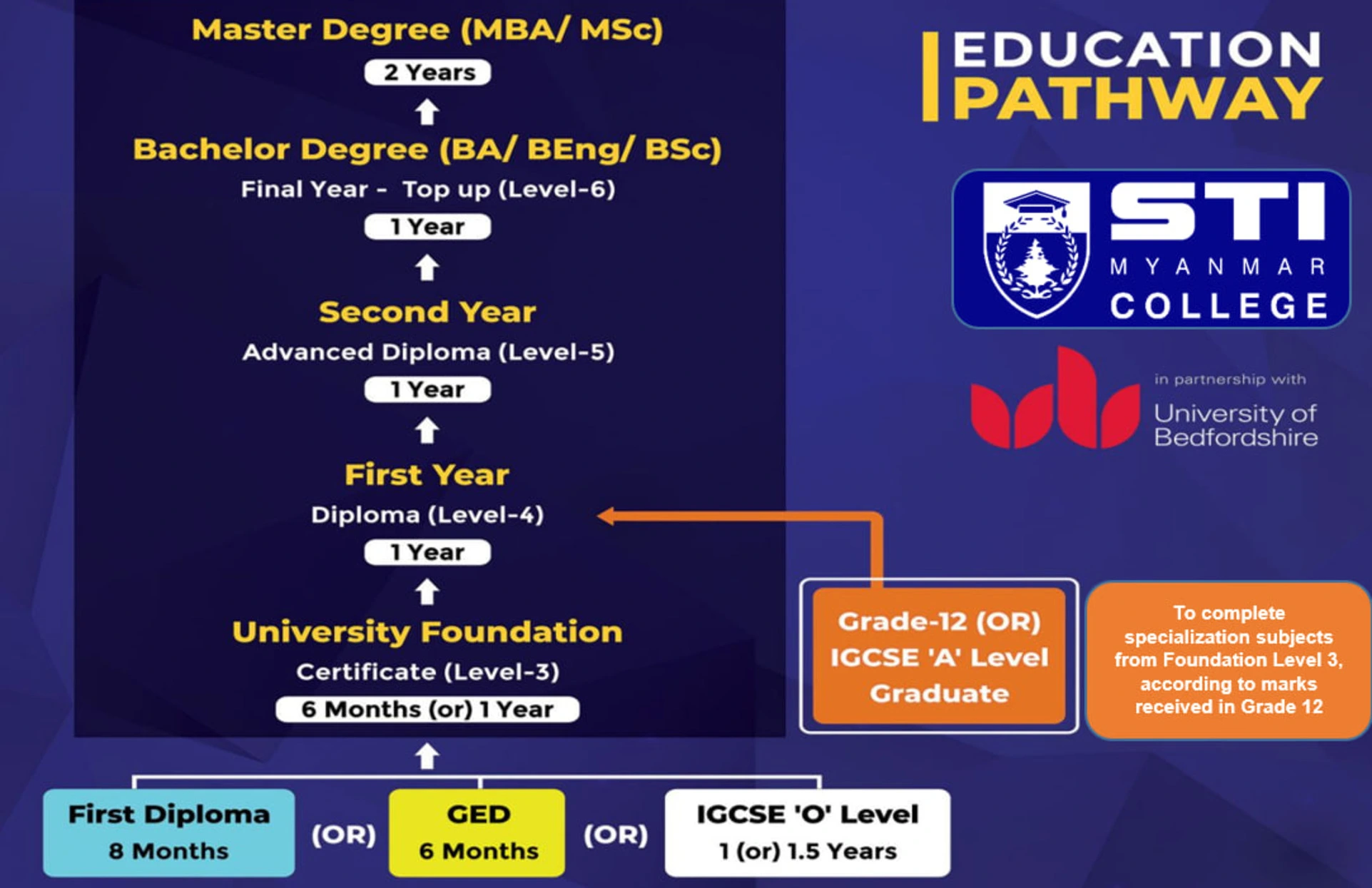
Entry requirements for every level — from Foundation to Final Year Top-up, plus Master programs. Applicants from other institutions may be considered on a case-by-case basis through the Recognition of Prior Learning (RPL) process.
Study period: 8 Months
Foundation certificates are issued upon completion, awarded by STI.
Study period: 1 Year
Diploma certificates are issued upon completion, awarded by STI.
Study period: 1 Year
Advanced Diploma certificates are issued upon completion, awarded by STI.
Study period: 1 Year
Bachelor's (Honors) Degree Certificates are awarded by the University of Bedfordshire, UK.
Total Study Period: 4 Years
Master Degree Certificates are awarded by the University of Bedfordshire, UK.
Diploma Certificates are awarded by London Teachers Training College (LTTC), UK.
Prepare the following documents for your application:
Application Form
Completed and signed
Academic Certificates
Matriculation / IGCSE / GCE O Level
Transcript of Records
Official transcripts from previous institutions
NRC Card
Copy of National Registration Card
Family Member List
Census list
Recommendation Letter
Written in English
Other Certificates
Any additional qualifications
Passport Copy
If applicable
Passport Photos
Any colour background
To ensure your application journey is completely smooth, we've kept the steps simple and direct. Plus, our dedicated Admissions team is just a message away if you need any support.
Start your application →Applying with prior qualifications? Skip to the RPL & Credit Transfer section.
Part C of STIMU Academic Regulations
Against the background of globalization, students frequently move from one tertiary institution to another, whether in their own country or internationally. To provide and promote opportunities for all students to succeed globally, recognition of a student's prior learning (RPL) is essential to ensure transportability of qualifications and awards.
RPL has two widely recognized forms: prior certificated learning (RPCL) and prior experiential (or informal) learning (RPEL).
RPL is a method of assessment. It considers whether an applicant can demonstrate that their prior certificated learning matches the learning outcomes of the modules/units delivered at STIMU at a given level, or whether an applicant is able to demonstrate that they can meet the assessment requirements for a module/unit through knowledge, understanding or skills they already possess through work or life experiences and do not need to develop these through a formal course of learning.
Unlike exemption above this process applies to previously certificated achievement of credits which can be transferred to other qualifications where permitted under the awarding organization's rules of combination.
STI Myanmar College's provision for RPL seeks to ensure that applicants are admitted to the highest level of award for which they are qualified and for which they wish to apply, and that they are awarded the maximum amount of relevant credit to which they are entitled by virtue of their prior learning achievements. These principles apply equally to pre-entry, post-entry or credit transfer applications.
Direct entry — Students may be admitted to a degree program in one of the later stages (Level 5 or 6), having already completed the exact equivalent of the earlier stage(s) on a different program. They will be recorded as "exempt" from the earlier stage(s), and this exemption will be reported on each issue of the student's achievement record.
Entry with advanced standing — Applies where the previous study does not cover all the credit requirements for a stage. The credit equivalence of the modules/units that are not listed in the award transcript must be established and recorded through the RPL procedure and verified with the applicant's HEI or professional body, as applicable.
Following an application to an HE program, the applicant may be invited to an interview to discuss entry requirements to the program and the content of the program itself. The interviewer and / or the applicant may wish to raise the possibility of RPL at this stage.
If RPL is considered an option, then the student must collate the relevant evidence against the requirements of the specific unit(s). Where appropriate an assessment plan or tracking sheet may be used to assist the student ensure all evidence is collated. The evidence gathered must meet the standards of the unit(s).
All applicants wishing to claim RPL for admission to STIMU must submit a verified certificate of completion of studies, a transcript of results for each stage and module, together with a copy of the full Module Specification for each module studied. The Module Specification may be via a web link or a paper copy.
Assessment as part of RPL is a structured process and requires an assessor to make a judgement about a student's prior learning and experiences in relation to unit standards. The assessor may then be required to look at work experience records validated by managers, previous portfolios of evidence put together by the student or essays and reports validated as being the student's own unaided work.
Assessment must be valid and reliable to ensure the integrity of the award of the modules/unit(s) and as such the evidence gathered and assessed must meet the standards of the modules/unit(s). If the collated evidence of RPL is assessed as not being sufficient to meet all the requirements of the modules/unit(s) then the applicant will have to complete the normal assessment for the modules/unit(s), usually by way of completing a bridging course.
The assessment process for RPL is subject to the usual quality assurance processes including internal and external verification.
RPL processes are subject to the usual quality assurance processes including internal and external verification / moderation. If following moderation it is determined that there is not enough evidence to claim RPL for a unit(s) then the student will have an opportunity to provide more evidence or undergo normal assessment requirements.
An interview with members of the Academic Board may be included at this stage, to consider whether admission or admission with advanced standing is possible or whether a bridging course is required. Confirmation of granting of RPL will be at the discretion of the Academic Board, following the assessment advice of the Dean, Head of Department or Program Leader. Once the verification processes have been conducted satisfactorily then certification claims may be made by STI Myanmar College.
As with any assessment decision on procedural grounds, a student may appeal using the STI Academic Appeals procedure.
For direct entry to Levels 5 and 6. For consideration by Academic Board. Applicant to complete Parts A and B only.