
Build foundational infrastructure expertise with a UK-validated Level 4 Diploma in Civil Engineering. Master structural mechanics, surveying, sustainable design, and workshop practices.
Civil engineering is a key area to support the national development of Myanmar. The Diploma year (Level 4) introduces students to the essential skills, knowledge and attributes required for civil engineers. The course helps students develop competence in the study of mathematics for engineers, mechanics, drawing, practical skills, sustainability and surveying with creative ideas. A professional approach to civil engineering is encouraged from the outset, including building relationships as an individual and as a member of a team, such as in undertaking a supervised group project on a negotiated topic. The four threads of design, sustainability, health and safety risk management and professional and ethics are embedded within the course.
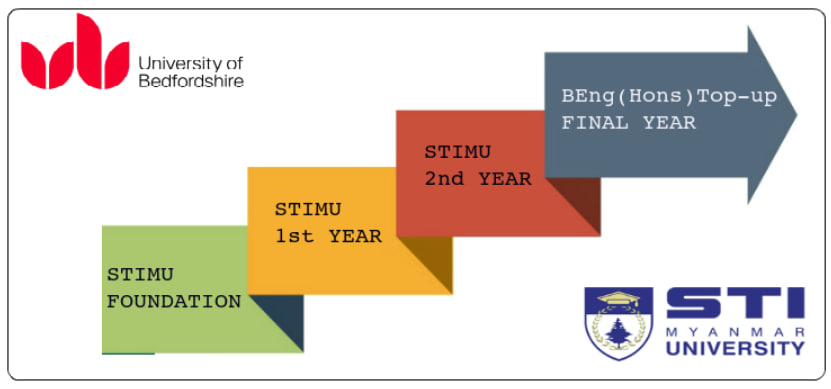
The STI MU Diploma in Civil Engineering (Level 4) provides the first of three years of full-time study which culminates in the BEng (Hons) Civil Engineering (Top-up) at Level 6, awarded by the University of Bedfordshire, UK.
Educational Aims of the Course
This course aims to achieve the following for its students:
🔨To lay the foundations for becoming an engineer who is practical, articulate, numerate, literate, creative and flexible
🔨To Introduce the concepts and principles of civil engineering, and to help students understand to evaluate and interpret these creatively
🔨To enable students to present, evaluate and interpret statistical data in order to understand the performance of systems and components
🔨To introduce the wider professional responsibilities of civil engineers, including code/s of conduct, working within an ethical framework, health and safety, risk management, environmental, sustainability and societal issues
🔨To provide an educational foundation for a range of studies directly relevant to civil engineering, including commerce, enterprise, marketing, innovation and creativity
🔨To acquire technical proficiency in design skills, allowing students to look for safe, economic and creative solutions to practical problems
🔨To develop a range of transferable skills, techniques and personal attributes essential for successful performance in the professional workplace, and which require the exercise of some personal responsibility
Intended Course Learning Outcomes
By the end of the course, students should be able to:
🔨LO1: Identify the basic scientific principles that underpin relevant engineering technologies and systems
🔨LO2: Use relevant materials, equipment, tools, products and processes in a civil engineering workshop
🔨LO3: Select and apply mathematical and statistical methods which support the modelling and analysis of engineering problems
🔨LO4: Be aware of the commercial, economic, and social contexts of engineering processes
🔨LO5: Apply engineering analysis to solve practical engineering problems, and recommend solutions
🔨LO6: Be aware of constraints including environmental and sustainability limitations; legal, ethical, health, safety, hazard and risk issues; intellectual property; codes of practice, protocols and standards
🔨LO7: Apply design techniques, and show creativity and originality in work produced
🔨LO8: Communicate ideas and technical information effectively in different formats, including orally, verbally and graphically
🔨LO9: Explain and apply the use of spatial information in design and construction projects
🔨LO10: Work effectively as a member of a team, recognising factors that affect team performance
Teaching and Learning Methods
🔨Acquisition of core knowledge is through a mixture of lectures, presentations, demonstrations, laboratory sessions, field trips, experiments and self-directed study
🔨Analytical thinking skills are developed through discussion and test questions.
🔨Practical skills are developed through laboratory experiments, the use of simulation software and workplace experience
🔨Transferable skills are developed through assignments and presentations, particularly in the project unit.
Junior Civil Engineer, Site Engineering Technician, Assistant Surveying Technician, Construction Project Assistant, CAD Draftsperson (Civil), Structural Technician
Successful completion of Foundation Certificate in Engineering Level 3
Certificate holders from other relevant disciplines will be considered for entry to Level 4 based on individual qualifications.
Applicants with relevant work experience may be considered on a case-by-case basis for Recognition of Prior Learning (RPL)
IELTS (4.5 overall, 4 individual) or equivalent qualifications
| Unit Code | Level | Credit | Unit Name | Core / Option |
|---|---|---|---|---|
| BE 2101 | 4 | 7.5 | Mathematics II | Core |
| BE 2102 | 4 | 15 | Graphical Process for Design | Core |
| BE 2103 | 4 | 15 | Applied Mechanics | Core |
| BE 2107 | 4 | 15 | Construction Materials (Timber and Masonry) | Core |
| BE 2109 | 4 | 15 | Organization and Procedure of Construction (Health and Safety ) | Core |
| BE 210E | 4 | English | Core | |
| BE 2101 | 4 | 7.5 | Mathematics II | Core |
| BE 2105 | 4 | 15 | Mechanics of Materials ( Soil & Fluid Mechanics) | Core |
| BE 2106 | 4 | 15 | Sustainable Design | Core |
| BE 2104 | 4 | 15 | Surveying | Core |
| BE 2108 | 4 | 15 | Construction Plant in Civil Engineering (Health and Safety) | Core |
| BE 210E | 4 | English | Core |
Duration
1 Year
Intake
July, November
Awarding Body
STI Myanmar College
Tuition
Contact admissions for current fee schedule
This website uses cookies to improve your experience. By clicking "Accept All", you consent to our use of cookies. Learn more